Browne's Folly Geology Walk

A tramp through geological time. Explore and discover the rocks and fossils laid down during the Jurassic period at Browne’s Folly.

Distance

1.8 miles / 2.9 km

Duration

1 to 1.5 hours

Difficulty

May be steep slopes, moderate fitness

Shape

Circular

Last reviewed

15/04/2026

Route description

A short walk with some exposed parts, steps and steep slopes which require care. There are no stiles. Ignore the post markers and instead use what3words to help locate the stopping points.

The nature reserve is managed by Avon Wildlife Trust. Please follow the Countryside Code, keep to the main paths. Do not enter underground quarries or areas closed off due to the dangers of ash dieback. Do not use hammers to take samples from rock faces.

Start

Address

37 Farleigh Rise, Monkton Farleigh, Bradford-on-Avon BA15 2QP, UK
View start on Google Maps

OS Grid Ref

ST 797663

What3Words

learns.influencing.sweat

Travel Info

Avon Wildlife Trust car park, Prospect Place, Bathford.

Navigation

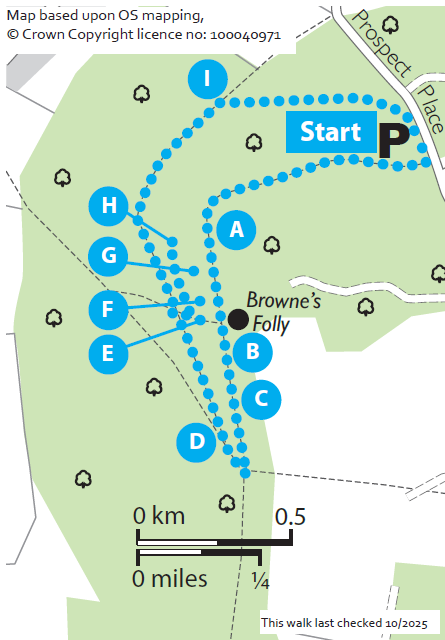
Exit the car park, turn right onto the road and then right again at the footpath sign. Follow the path for about 300m to where the trees have been cleared and it opens up to a view across the valley. Ignore the gate and continue on the level for 30m A. W3W hammer.quest.glass

The ground you are standing on is about 170 million years ago and is the same age as the hilltops ahead of you. Sediments were deposited in shallow tropical seas when the area was located just north of the equator. Later various ice sheets covered much of Britain not too far north of here. When temperatures warmed the resulting meltwaters eroded away rocks to create deep valleys.

Continue on the path to reach the tower at B. W3W ///inch.landed.little

Twenty-one metres beneath you is Monkton Farleigh stone quarry where Bath stone was extracted from the Jurassic rocks. Browne’s Folly Tower was erected in 1849 by one of the quarry owners (Wade-Browne) partly to showcase the quality of his building stone, but also to provide quarrymen with work when demand for the stone fell.

The trail now proceeds to various locations where rocks are exposed.

Keeping on the same level as the folly, continue along the path in a southerly direction until you pass two depressions on the right. Go around the edge of the second depression and back on yourself on the other side until you are between the two depressions. Carefully walk down the slope and onto some steps into the second depression to view a rock face at C. W3W loans.happen.basket

The shelly hard limestone formation at the top is Forest Marble. This is not a true marble but is suitable for rough building work. At the bottom, in the Upper Rags, you can see cross bedding layering at different angles to the horizontal main bedding plain, when the flow came from different directions depositing material on the lee side of mounds, possibly in an ancient tidal delta.

Retrace your steps to the path by the wall, turn right and continue along the path until a path comes in on your left and another descends to your right. At the junction turn right down the slope onto steps. Stop at the 15th step marking point D. W3W vote.assist.drain

To your right is an old entrance to Monkton Farleigh Stone Quarry. The rock below the entrance marks the top of the Bath Oolite Stone formation, which is 7m thick.

Continue downwards to the route of an old tramway used to take stone from the quarry. Turn right and walk northwards for 250m to pass through a gate. To your right is Browne’s Folly. Follow the path up onto steps for three quarters of the way to the folly where, on your left, you see a small rock with holes, marking E. W3W loans.firm.motor

This is called a sponge rock because it was originally thought that the holes were left from burrowing of soft body sponges which were later filled then eroded away. Now it is thought to be burrows formed by crustaceans such as shrimps.

Return to the bottom of the steps. Turn right and right again until you reach a rock outcrop with a gated quarry entrance marking point F. W3W game.crop.laser

This location provides a clear section of rock formations The lowest and oldest formation below the gated entrance is called Bath Oolite, and was quarried for building stone. It was formed by deposition of tiny spherical grains of calcium carbonate called ooids which are cemented together. The stone does not contain many fossils making it easy to cut in any direction. Look for ooids in the lighter block of stone in the outlier rock.

Bath Oolite stone has been quarried since at least Roman times. Extraction was expanded in the 18th and 19th centuries to help build Georgian Bath. The stone was taken out by horse and cart or on trucks along tramways. Quarrying ceased here in 1920 leaving behind an extensive network of underground passages, now the home for bats.

Above the Bath Oolite is the younger hard Roof Bed that supports the quarried tunnels. Above this is the White Oolite in the Upper Rags formation which has some fossils deposited in tranquil waters and is not suitable building stone. The uppermost and youngest rocks are in the Forest Marble formation.

Go back down for a short distance and turn right along a narrow footpath for 35m and follow another narrow path up on the right. Stop near the post. This is point G. W3W remedy.herds.puppy

White Oolite and the lower boulders of the Roof Bed can be seen here. Look on top of the boulders to see oyster shells, bivalves and worm trace fossils.

The White Oolite rock here represents sediments laid down in a tranquil marine environment and consequently, fossils can be found here. Look carefully to see oyster shells, bivalves and trace fossils from worm holes.

Retrace steps down to the track, follow this north again for a short distance and look to your right to see a sandy coloured rock face marking point H. W3W lunch.socket.counts

This is the remains of a small coral patch reef cluttered with oyster shells.

From point H, retrace your steps back to the path and turn left back to the gate. At the gate turn around and follow the path diagonally downhill.

Go through a gate into the wood and onto a junction with a wide track. Turn right at this junction and follow the path to an large fallen rock slab on your right. Just beyond the slab is I. W3W refers.dress.bill

Slabs have broken off from the crag behind because the weaker underlying formation containing clays has eroded away.

Go back down to the path and return to the Avon Wildlife Trust car park.