Corsham to Colerne Peacock Trail

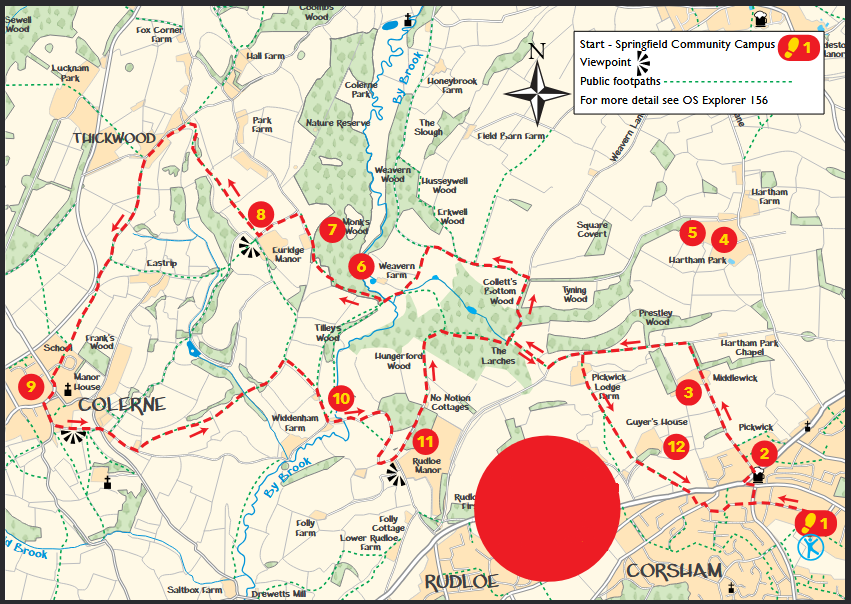
This walk seeks to explore the area between Corsham and Colerne exploring the hidden valleys and hills that provide far-reaching views.

Distance

10 miles / 16.09 km

Duration

3.5 to 4 hours

Difficulty

Uneven, steep slopes, good fitness

Shape

Circular

Route description

The walk is 9.88 miles long and has a total ascent of 1481 feet and follows Public Rights of Ways (PRoW). It is a challenging walk, on footpaths and bridleways, with some steep gradients or rough terrain and across fields with a number of stiles to climb over. Suitable footwear and clothing is required as parts of the walk are through woodland and occasionally muddy footpaths.


Start

Address

1 Beechfield Rd, Corsham SN13 9DL, UK
View start on Google Maps

OS Grid Ref

ST866704

What3Words

pioneered.chairs.beard

Travel Info

The walk starts at the Springfield Community Campus on Beechfield Road, SN13 9DN. There is a public car park to the rear of the Campus and the nearest bus stops are at Newlands Road, SN13 0BH and Valley Road SN13 9DT.

Navigation

1 Springfield Community Campus. The walk starts from the Springfield Campus built in 2015 to replace the old Corsham Library and Community Centre. In WWII this area was once the Married Quarters Site No.1.

Turn left and follow Beechfield Road to Valley Road and turn right towards Pickwick Road and left to the Hare and Hounds.

2 Pickwick village was once a separate settlement from the Corsham community and now forms the northwestern part of the town. The name derives from the Anglo Saxon word pic (meaning a peak or pointed hill) and wic village). Corsham was the inspiration for Charles Dickens’s novel The Pickwick Papers. It is said that he borrowed the name from Moses Pickwick, a coachman who was born in Pickwick, lived in the “Hare and Hounds” inn, and ran coaches between Bath and London. Samuel Pickwick is a fictional character and the main protagonist in The Pickwick Papers, the first novel by author Charles Dickens.

Turning right at the Hare and Hounds, cross the main A4 road and turn right taking the first turning on the left up Middlewick Lane past the allotments on your right to Middlewick House on your left.

3 Middlewick House is the home of Pink Floyd drummer Nick Mason CBE and his actress wife Annette Lynton Mason, who acquired it from the previous owners, Andrew and Camilla Parker Bowles, now Camilla, Duchess of Cornwall, in 1995. The Masons occasionally open the gardens to visitors, to raise money for charity.

Continue up the avenue of trees and turn left towards Hillsgreen Lodge. On your right can be seen Hartham House & Park.

4 Hartham House & Park. Originally a former Tudor farmstead in the 15th century and was replaced by Hartham House that was built between 1790-1795. Originally designed by James Wyatt, and set today in 50 acres that was landscaped by Harold Peto the famous garden designer of the late Victorian period. From the time of the Battle of Britain onwards, the upper floors were used as dormitories housing one hundred members of the Women’s Auxiliary Air Force from the Royal Air Force’s No. 10 Group, RAF Fighter Command, based at the nearby RAF Rudloe Manor. Hartham Park is now an active business campus.

Continue past Hillsgreen Lodge on to the gravelled road towards Pickwick Lodge Farm. This gravelled road was once the main turnpike road from London to Bath, established in the 1600s.

5 Stické Tennis Court. As you walk along the Turnpike Road on your right on the horizon to the left of Hartham House, is the Grade II* listed wooden 1904 Stické Tennis Court building. This is one of only three remaining Stické Tennis Courts in the world. Corsham has a Stické Tennis Club.

With Pickwick Lodge Farm on your left go through the kissing gate and follow the path to the edge of the fence and then turn right going downhill though a kissing gate. Then taking care go steeply down hill to reach the bottom left of the valley floor. Go through the kissing gate and turn right, going uphill follow the track until you reach Weavern Lane. Turn left and continue along the lane downhill until reaching a bridleway gate on your left. Go carefully downhill, turn right to reach Weavern Farm on your right.

6 Weavern Mill was probably named after the meandering banks of the Bybrook. It was known as Veverne Mill in the 16th century. In 1595-1608 three water mills were housed under one roof: one ancient fulling mill, one recent corn mill and one recent fulling mill. This mill was also making paper in 1802. It ceased working in 1834 and there is now only a disused leat to the east of the Bybrook to tell of its existence.

Continue ahead on path over the By Brook and take next footpath uphill on the right into Monks Wood.

7 Monks Wood is a significant tract of ancient woodland with a river running alongside which is managed by the Woodland Trust. The wood provides habitats for many species of fauna and avifauna as well as rich ground flora including the scarce Solomon’s Seal and Star of Bethlehem.

Follow footpath through three kissing gates to emerge in to field with far reaching views to the right.right Follow footpath adjacent to fence line on the left. Turn left at lane to pass Euridge Manor.

8 Euridge Manor was once owned by Sir Walter Raleigh and is currently owned by Mr John Robinson of Jigsaw fame, who bought the farmhouse and the 300-acre ‘two-overcoat’ farm – so called because it’s always a few degrees colder than anywhere around. The Farm is now a wedding venue and events location.

Take the footpath on the right and follow it through several fields until reaching the road at Thickwood. Turn left and follow road until it bends right, take the bridleway on the left then a footpath going across a field to enter Colerne. Turn left on main road and follow to the marketplace.

9 Colerne. Known as the village on the hill and this sum up both its position and much of its history. The parish borders Gloucestershire and Somerset to the west and the Three Shires Stone where the three counties meet, is on the parish boundary. The earliest settlement seems to be at Bury Camp, and Iron Age promontory hill fort to the north of  the parish. The Bury Camp site covers 32 acres and has three entrances. The Fosse way forms the western boundary of the parish and there are several possible Roman sites nearby. The major one is a villa from the 4th century AD. The real growth of the village and its amenities was to come from the construction of RAF Colerne. Unlike many World War 2 airfields this was always planned as a permanent RAF Station and was specifically equipped as a Blind Landing System airfield. During the Battle of Britain RAF Colerne was used to reform and re-group many of the fighter Squadrons engaged in the daily battles over the South Coast. The RAF station closed in 1976 and was handed over to the army for use as a barracks. The barracks is currently the home of 21 Signal Regiment.

Turn right in the Marketplace and as you leave turn left down Tutton Hill. After passing a stone water trough take the next lane on the left. Go straight over crossroads and downhill until reaching footpath on the left. Into fields heading diagonally right to a stile adjacent to gate.

Go diagonally left across the field to hedgerow opposite and down the steps to cross a stream. Bear diagonally right uphill over stile and follow fence line on your right until meeting bridleway. Turn right follow bridleway downhill to Widdenham Farm. Please note the bridleway is steep as you approach Widdenham Farm.

10 Widdenham Farm is a dualpurpose farm and mill located adjacent to the By Brook, the buildings have been used for corn milling and fulling but have now reverted to farming.

Follow track through farm, over the By Brook and continue on track going left uphill between hedgerows to emerge at lane opposite the former RAF Rudloe Manor. Turn left. The ex RAF Rudloe Manor site is a short detour on the right with magnificent views down the By Brook valley from the entrance to Folly Farm.

11 RAF Rudloe Manor. The station was established on top of quarries from which Bath Stone had been extracted. In the 1930s some of the tunnels had been converted for use as a Central Ammunition Depot. The vast caverns had some 2,250,000 square feet (209,000 m2) of space, divided into many smaller chambers. During the Second World War, the Operations Centre of No. 10 Group RAF was housed there in three buildings: Operations Room, Filter Room and Communications Centre, which were partially buried for protection.

The area covered by No. 10 Group during WWII encompassed southwest England and South Wales. RAF Rudloe Manor is known as “Britain’s Area 51. Declassified secret files released at the National Archives indicated the site was the centre for UFO investigations in the 1950s.

Follow lane past No Notion Cottages to enter wood. Proceed downhill and fork right at stone gate post, go carefully downhill. At kissing gate go right uphill. Retrace steps back to Pickwick Lodge Farm but this time turn right down Guyers Lane. Take footpath on the left across two fields to reach the A4, passing Guyers House on the left.

12 Guyers House is hidden in the trees to the left / north-west. Originally, it was a one-room farmhouse owned by the Snelling family who named it ‘Snellings’ in 1670. Around 1830, it was renamed ‘Guyers’. Today, it is a 37 en-suite bedroom Hotel & Restaurant.

Turn left at A4 to Pickwick; take care crossing A4, and retrace walk back to Springfield Campus.